Onyx, marble and quartzite: choosing stone that survives daily use
Which stones belong on a wall, which belong underfoot, and the honest conversation about marble that most showrooms avoid having.
January 20, 2026
Stone selection is the part of a bathroom project clients most look forward to and most often get wrong. Not because they choose ugly stone, but because they choose stone for a location it was never suited to. Here is how we think about it at the yard.
Hardness is not the only question
People ask which stone is hardest. It is the wrong first question. What matters in a bathroom is a combination of three things: how the stone reacts to acid, how porous it is, and how visible damage will be on that particular colour and finish.
Marble is calcium carbonate, so it reacts with anything acidic. A splash of lemon juice, a cleaning product, even some shampoos will etch the surface, leaving a dull mark where the polish has been chemically removed. Sealing does not prevent etching. Sealer reduces staining, which is a different problem entirely, and this distinction is the single most useful thing to understand before you choose.
A practical hierarchy
- Quartzite: hardest of the natural options, low porosity, excellent for floors, vanity tops and shower walls. Taj Mahal and Mont Blanc are our defaults when a client wants a marble look with a working life.
- Porcelain: technically not stone, but modern large-format porcelain is dimensionally stable, non-porous and available in convincing book-matched panels. In heavy-use family bathrooms it is often the right answer.
- Marble: exceptional on walls, tub surrounds and anywhere it will not meet acid daily. Honed rather than polished, because a honed surface hides etching far better.
- Limestone: warm, soft and beautiful honed. It takes patina rather than damage, which some clients love and others cannot live with.
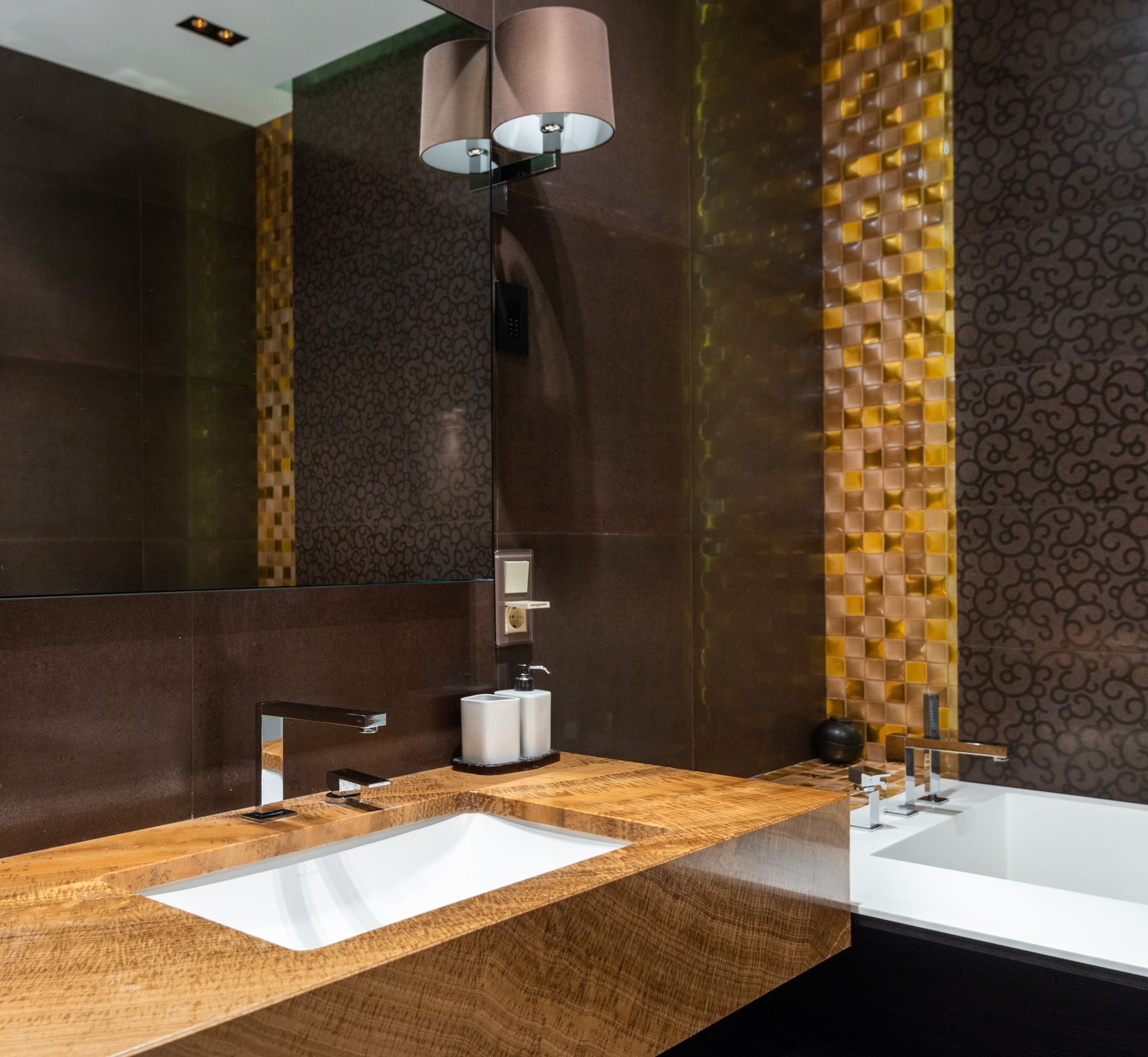
- Onyx: a feature material only. Backlit walls, vanity fronts, powder room panels. Never a floor, never a shower bench, never a vanity top that will see a dropped bottle.
Finish changes everything
The same slab behaves differently depending on how it is finished. Polished stone shows every etch and every water spot, and it makes a dark room into a hall of reflections. Honed stone hides etching, reads warmer and is safer underfoot. Leathered finishes add texture and hide even more, at the cost of being slightly harder to wipe clean.
In our dark rooms we hone almost everything. A polished floor in a low-lit bathroom bounces the little light there is straight back at you and undoes the atmosphere the lighting design is trying to build.
Buy the block, not the slab
For any feature wall, buy every slab from the same block at the same time, and ask the yard to hold a reserve piece. Blocks are quarried, cut and sold as units, and once the remaining slabs from your block are gone, matching is effectively impossible. Dye lots do not exist in stone; geology does.
This matters most with dramatic material. Calacatta Viola from two different blocks will look like two different stones. We photograph and number every slab at the yard, then dry-lay them on the shop floor before anything is cut, so you see the finished wall as a layout rather than as a promise.
Sealing prevents staining. Nothing prevents etching except choosing a stone that does not etch, or accepting that it will.
The conversation we always have about marble
When a client falls in love with a marble for a heavily used family bathroom, we ask two questions. Who cleans this room, and what do they clean it with? If the answer involves a bathroom spray from a supermarket shelf, the marble will etch within a month.
That is not a reason to avoid marble. It is a reason to put it where it will thrive, which is usually the walls, and to put quartzite or porcelain where the daily abuse happens. Nearly every bathroom we build mixes materials for exactly this reason, and nobody has ever noticed the mix as a compromise.
Care, honestly
Wipe standing water off stone tops. Use a pH-neutral cleaner, not a bathroom spray. Reseal porous stone roughly every eighteen months, or when water stops beading. Keep acidic products on a tray rather than directly on the counter. That is the whole regime, and it takes less effort than most people fear.